Choosing privacy
Smart Film or Blinds? Start with the Privacy You Need.
The right choice starts with the room. A privacy problem, a dark-bedroom problem and a heat problem can need different solutions.
Choose the result before the product
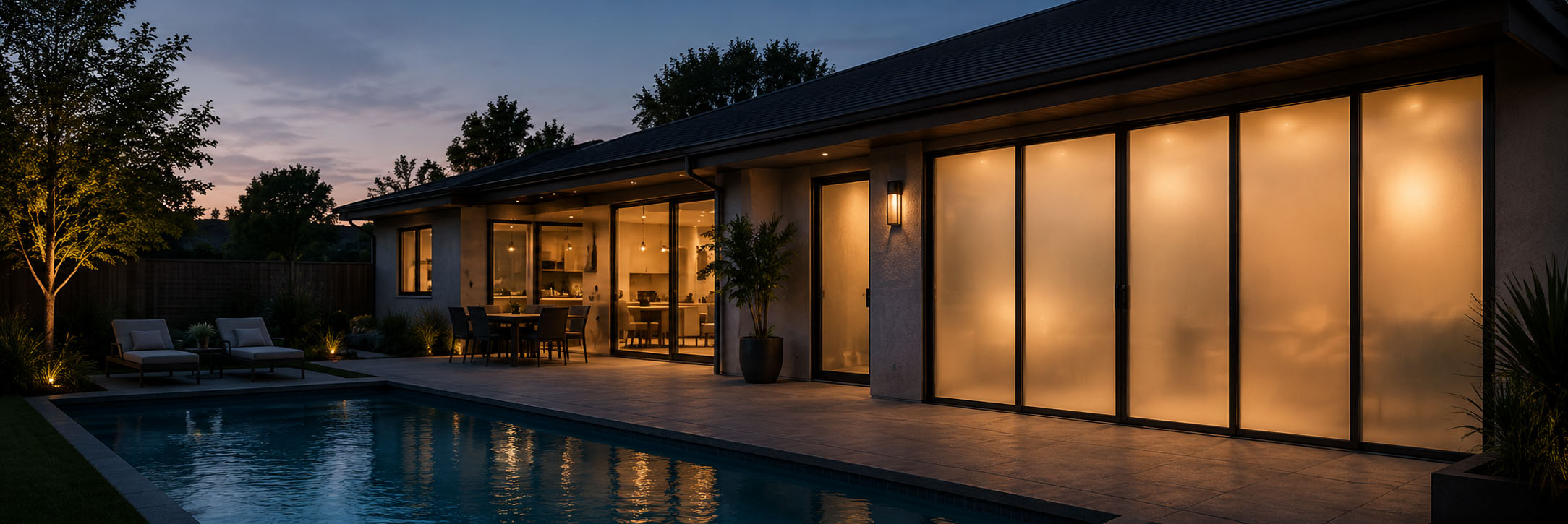
Smart film changes the visibility through suitable glass. In the clear state, you can see through it; in the frosted state, the view is obscured in both directions. Blinds and curtains change the opening physically. Consider how often you need privacy, whether you want a view at other times and what visible hardware you are comfortable with.
Separate privacy from blackout
Standard frosted PDLC transmits diffused light. It is not a substitute for a verified blackout solution. If your priority is a dark bedroom or a room for projection, ask for the selected product’s measured light-transmission information. A darker-looking film alone does not establish blackout performance.
Look at the glass and the wiring
Retrofit film is applied to suitable existing glass. Glass condition, coatings, frames, moving doors and the route to power all need review. Finished homes can be assessed; a remodel is not a requirement. New construction can make concealed wiring easier to coordinate.
Check your real viewing conditions
Review the clear and frosted appearance from normal seating and standing positions, during the day and with room lighting on. Some clear-state haze can remain. Strong backlighting or a person close to the glass can reveal silhouettes in frosted mode.
What to share for a useful recommendation
Start with the room, your city and the privacy problem. A photo of the whole opening and an approximate size help, but you can inquire without them. Mention room darkening, glare or heat concerns separately so they are not mistaken for visual-privacy requirements.
Keep Planning
Product-specific recommendations and commercial terms must be confirmed for the actual installation.