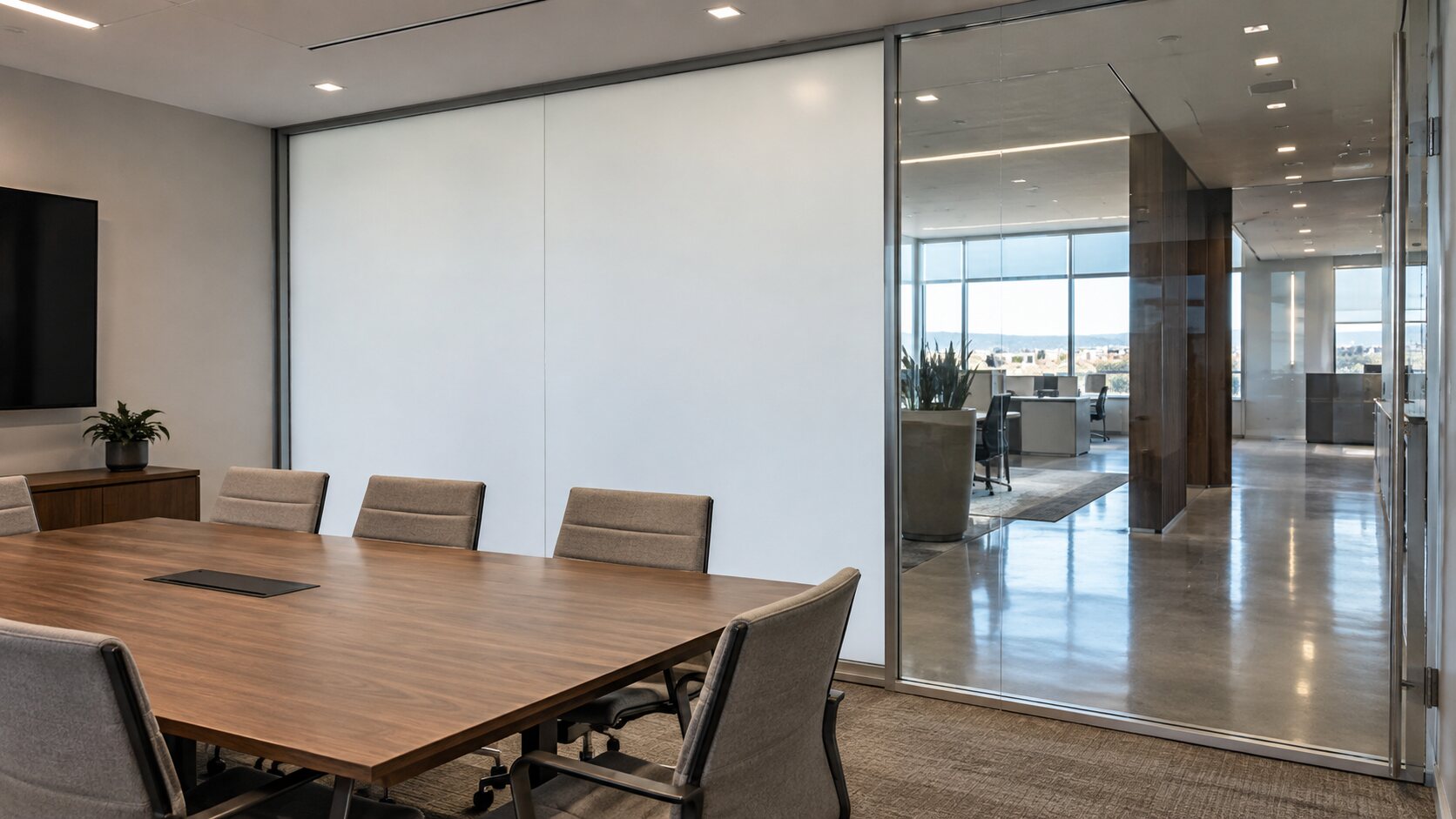
Start with the privacy the room actually needs
Walk the corridor and look into the room from seated and standing positions. Are you trying to screen people, a wall display or documents on a table? Does that screening need to be permanent, or only during certain activities?
Visual screening does not establish acoustic confidentiality.
When fixed frosted film is the better fit
Fixed frosting makes sense where nobody needs a clear view through the treated area. It avoids adding an electrical switching system to a pane that should stay screened.
The finish still matters. For example, 3M's FASARA Frost and Matte range includes different light-transmission levels and surface finishes. That manufacturer example illustrates why “frosted” is not one uniform specification. Check the actual proposed product; it does not establish the properties of another supplier's film.
A decorative band and a full-height treatment also screen different sightlines. Review the coverage against the room's use, not just the appearance of a sample.
When the changing view is useful
Switchable film can suit a room that should stay visually connected to the workplace between private meetings. Its value is the change of state, rather than a claim that every room needs more technology.
Obscura's film selection guidance explains that clear-state haze and appearance vary with the film and viewing conditions. Clear mode allows a view in both directions. Frosted mode obscures both directions; it does not preserve an unobstructed view out while concealing everyone inside.
Obscura's privacy guidance also cautions that strong backlighting or someone close to the pane can reveal silhouettes. Assess the specified film with the room's lights, screen positions and likely viewing distances. Where privacy is especially sensitive, define what must be concealed before choosing the product.
Treat glare and presentation darkness separately
A room can be visually private and still have an uncomfortable reflection on a monitor. OSHA's workstation guidance recommends assessing screen orientation, light sources and window coverings when addressing glare. Those are useful checks for an office with bright exterior windows, even when its internal glass partitions already have privacy film.
For presentations, specify the required darkness separately. Standard frosted PDLC continues to pass light. Its frosted appearance is not evidence of blackout performance or a measured reduction in solar heat.
Compare the complete project
Obscura's current smart film pricing guide gives a planning range of $65–$80 per square foot for film and application. Power equipment, electrical work, delivery and repairs can add to the total.
Ask each supplier to identify the film, coverage, controls, independently switched areas and wiring responsibilities. Review the cable route before installation, including any visible covers or finishing work. For fixed film, confirm the selected finish, glass compatibility, preparation and installation scope. Request the written care and warranty terms for either option.
You may choose fixed frosting where screening is permanent and smart film only where switching serves a clear purpose. Send your location, approximate panel sizes, photos and privacy requirements so we can assess the fit.
Discuss your commercial project, review installation requirements, or request an estimate.
Common questions
Does smart film need electricity?
Yes. Switchable PDLC requires compatible power equipment, wiring and controls. Confirm the selected system’s power-off behavior; standard clear-on PDLC returns to frosted when power is removed.
Can smart film be installed on existing office glass?
It can be considered for suitable existing glass. Assess the glass condition, coatings, frames, moving doors and cable routes before confirming fit.
Is frosted smart film a blackout solution?
No. Standard frosted PDLC admits diffused light. Specify presentation darkness separately rather than treating a frosted appearance as blackout performance.